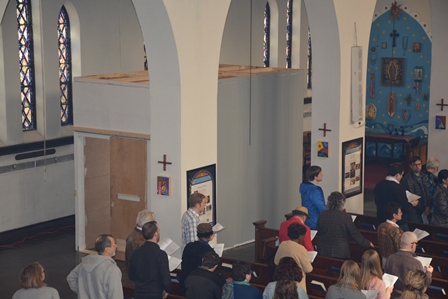
Spending just five minutes in solitary confinement makes me wonder how people can stand it for days at a time. What does doing nothing and having no interaction do to one over a long period of time? Psychologically, mentally etc? We need to stop this!!!
~ Anonymous participant at Ecumenical Advocacy Days, April 17-20, 2015
Spending 15 minutes in solitary confinement was an odd and unnerving experience. I'm an introvert so I enjoy solitude and alone time but this was a bit extreme even for me. The constant light and noise was really hard to take and the bed was impossible to relax on. I cannot imagine having to do that for more than 30 minutes at a time. It seems so inhumane and cruel. What purpose does this accomplish? Who does it benefit? Who does it protect? I don't see the point. Just seems so wrong that people are subjected to this day after day after day for years or even decades. Not right at all.
~ Tad H., participant at Ecumenical Advocacy Days, April 17-20, 2015
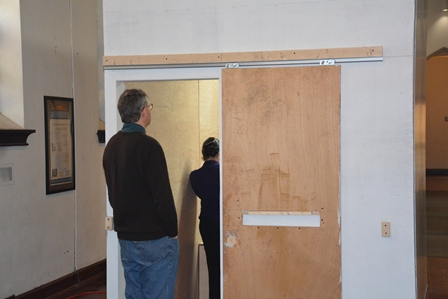
I spent two 15 minute sessions. The first I reflected on what was missing such as no sunlight, no company, no human touch, no since of time... I reflected as one outside thinking about what one inside would experience. In the second 15 minute sessions, I began to feel more personally connected with the experience. I thought of knocking on the door to end the experience at least 3 times, I felt anxious and weepy. I wanted to scream to stop the noise. I realized that there were no blankets or mattress. I wondered if the timing was right, it felt much longer than the first 15 minutes. I watched the door and waited for it to open.
This is a good experience but to live it for real would be devastating and inflicting this kind of torture on another is in fact cruel and evil.
~ Rev. Aundreia Alexander, Assoc. Gen. Of Justice and Peace, National Council of Churches
At Ecumenical Advocacy Days, April 17-20, 2015
I recognize – in this space – our capacity for unspeakable cruelty. A cultivated, sanctioned behavior . . . system – bound to oppress, humiliate – dehumanize the human – in order to justify policies which marginalize, break – the soul of Man.
As a mother of black sons, a grandmother of 2 black teenage boys – I have known this feared space for many years. It haunts me . . . haunts all people of color, people who are poor, sufferers of mental illness. I pray we find ways to restore our humanity. Those who torture – are also tortured; there is no escape!
~ S. B. Durham, from Pennsylvania, participant at Ecumenical Advocacy Days, April 17-20, 2015
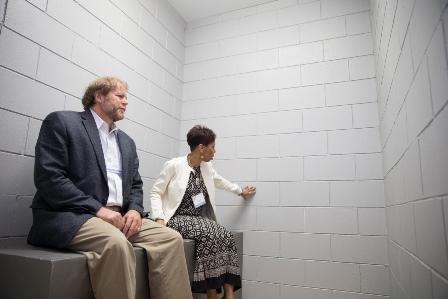
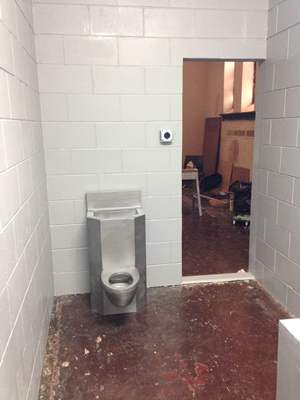
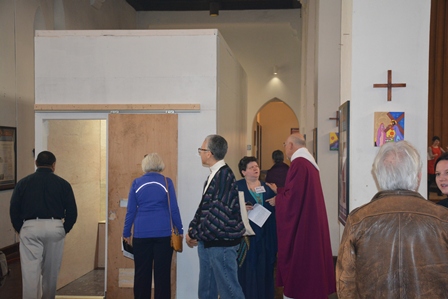
I spent 30 minutes in the solitary confinement cell on display at Ecumenical Advocacy Days 2015 in Washington, DC. Since I was bored, I did modified push-ups, sang hymns, looked to see if my fingernails were all the same length, and inspected the walls, floor, and toilet-sink combo.
I listened to the recording of the others howling, crying out, and beating on doors and walls with some kind of objects, and wondered what it might feel like to be or become mentally ill without access to medicine.
The tension I feel in my heart is this—if someone tortured and murdered someone I love, would I feel that a terrible confinement of that person was wrong? I feel the need to learn about imprisonment, its horrible effects on the imprisoned, and alternatives to isolated confinement.
Thank you to the National Religious Campaign Against Torture for providing me this experience.
God bless the tortured and those helping them.
~ Beth from Fort Worth, TX, participant at Ecumenical Advocacy Days, April 17-20, 2015
The life of a person in solitary confinement becomes one of the negative sensations. The negative sensations are the prisoners’ reality. The reality of neutral colors, cold stone, toxic audible ambiance with no sense of passage of time. The permanence is more than just negative reinforcement. It snuffs out hope and life. The solitude sets within the prisoner in such a way that the long term reciprocations are detrimental to psychological health with respect to the brain as it is only meant to take on a certain threshold of environmental stress. As this is such longterm solitary confinement is unethical and inhumane.
~ Blane B., participant at Ecumenical Advocacy Days, April 17-20, 2015
Unworthy, insignificant, forgotten, helpless - I could sense these feelings beginning to root during a brief 10 minutes in confinement. How does one begin to fathom these emotions for a duration of months? Days? Even hours? ALL human beings are of worth. ALL human beings are deserving of freedom. How can we put our brothers and sisters through such torture?
~ Keely V., participant at Ecumenical Advocacy Days, April 17-20, 2015
Initially my first thought was, 'okay, this doesn't seem fun.' But I remembered that I could leave whenever I wanted, there are countless people who can't. There are no windows, no breaks, no time, no civilization. It is just you, a toilet, four brick walls, a non-functioning light, and your thoughts. If I was truly in solitary, I would be plagued with thoughts. Indignant thoughts, thoughts of resignation, thoughts of guilt, thoughts of loneliness. Not just the kind where you feel detached from people, but the sort of loneliness where you could die there, in that small cell deep in a prison in the middle of the country, and no one will know or care. The only thing that you can truly think and question, do I even matter? Do I even exist? – It's impossible to prove otherwise.
~ Joe H., participant at Ecumenical Advocacy Days, April 17-20, 2015
I just do not understand. I do not want to understand the logic that allows a slow and painful death. Prisoners are human. Not human “too,” but human.
~ Anonymous participant at Ecumenical Advocacy Days, April 17-20, 2015
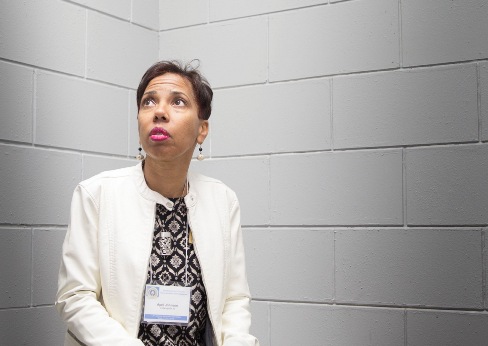
I just spent one minute in solitary confinement. The first impression was of the noise and of the lack of color – of cold hard gray all around me.
I could make it, I thought, if I could have access to books and writing materials. Are these allowed? How about occasional visitors?
~ Lucy F., participant at Ecumenical Advocacy Days, April 17-20, 2015
|
|



 Torture in U.S. Prisons